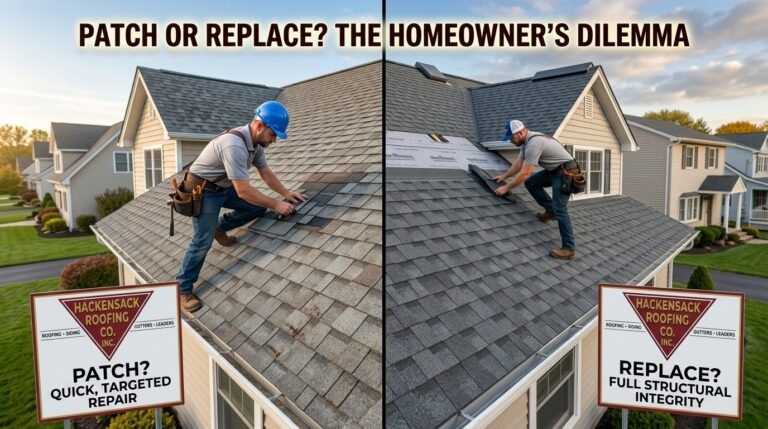
When a leak springs or storm damage strikes, every homeowner faces the same question: Can I get away with a quick patch, or is it time for a full replacement?
Choosing between a targeted repair and a new roof depends on the age of your system, the extent of the damage, and long-term costs. Fixing a minor issue quickly can save thousands, but patching a roof that is past its prime can waste money on temporary solutions when a replacement is inevitable.
When a Patch Is the Right Choice
A roof repair makes practical and financial sense when the overall structure is healthy and the damage is localized.
-
- Isolated Storm Damage: If a localized storm blows off a handful of shingles or damages a small section of ridge cap, a simple patch is usually sufficient.
-
- Minor Flashing Leaks: Water coming in around a chimney, pipe boot, or skylight often stems from dried-out sealant or damaged flashing—not failing shingles. Replacing the flashing or boot fixes the issue directly.
-
- Young Roofs: If your roof is less than 10–12 years old and generally in good condition, repairing localized wear is a cost-effective way to maximize its lifespan.
-
- Accidental Damage: A fallen tree branch poking a hole in an otherwise sturdy roof is a classic candidate for a quick, targeted fix.
Tip: Keep in mind that replacement shingles may look slightly darker than weathered existing ones, but matching the function is what protects your home.
Signs You Need a Full Replacement
When damage is widespread or structural integrity is compromised, patching becomes a temporary band-aid on a bigger problem.
-
- Advanced Age: Most standard asphalt shingle roofs last between 20 and 25 years. If your roof is approaching or past this mark, frequent repairs yield diminishing returns.
-
- Widespread Granule Loss: Check your gutters. If you see accumulation of heavy, sand-like granules, your shingles are losing their UV protection and reaching the end of their functional life.
-
- Curling, Buckling, or Brittle Shingles: When shingles curl at the edges or crack easily when touched, the asphalt has dried out. At this stage, trying to nail down a patch often damages surrounding shingles.
-
- Multiple Active Leaks or Sagging: Water penetrating in several areas—or visible sagging along the roofline—signals deep moisture damage in the underlying decking and framing that isolated patches cannot resolve.
-
- Recent Severe Storm Damage: Extensive wind hail damage across multiple slopes typically justifies a full replacement, often covered by homeowners insurance.
The True Cost: Patching vs. Replacing
While a repair has a lower immediate cost, patching an old roof repeatedly adds up fast. A new roof provides complete structural integrity, updated ventilation, new manufacturer warranties, and improved energy efficiency.
If you are unsure which route to take, our experts at Hackensack Roofing Company can help guide you. We provide honest feedback and free estimates to help you choose the option that keeps your home safe and dry.